
Aliases
- Tracked as Aurora or Aur0ra; no confirmed MITRE group designation or stable alternate operator name at the time of writing.
Get Threat Intel and Security Updates Delivered to Your Inbox.
Profiling
Threat Actor Type: Financially motivated ransomware operation using encryption, data theft, and leak-site extortion. Public trackers list 33 victim claims since April 2026.
Structure: Evidence supports an affiliate model: core operators maintain the malware and extortion infrastructure while affiliates conduct intrusions. One exposed Russian-speaking affiliate compromised more than 20 organizations across nine countries, with only four later appearing on Aurora’s leak site.
Operators: Communications recovered from the exposed server were written in Russian, consistent with a Russian-speaking operator or affiliate base. No individual identities have been publicly attributed.
AI-Assisted Operations: Recovered Cursor Agent sessions across ten targets show the operator using Claude Sonnet to accelerate network and Active Directory reconnaissance, privilege analysis, command troubleshooting, NTLM relay attempts, and AD CS exploitation. The operator still controlled access, decisions, malware deployment, and encryption.
Malware: Aurora uses Zig-based Windows and Linux/ESXi encryptors. The payload encrypts with ChaCha20 and wraps keys with RSA-4096. Its ESXi mode stops active VMs, encrypts key VM files, skips system volumes, and replaces the SSH banner with the ransom message.
Motivations
Financial extortion through encryption and stolen-data pressure. Researchers confirmed two victim payments and identified two more likely payments routed through shared laundering infrastructure.
Timeline & Victimology
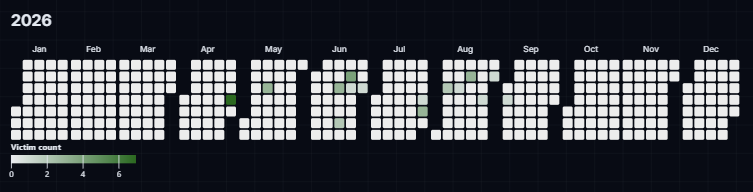
Figure 1: Victim heatmap.
April 2026 — Emergence
Aurora launches a public leak site and begins claiming victims across countries and industries.
April–July 2026 — Affiliate Campaign Documented
An exposed affiliate’s records show more than 20 compromised organizations across nine countries, including 17 with domain-level or interactive access. Only four were posted publicly.
May–June 2026 — Escalation
Claims peak at 11 in June. Manufacturing is the largest visible concentration, but victims span numerous sectors.
August 2026 — Help-Desk Social Engineering Intrusion
In one intrusion, attackers paired email flooding with fake IT-support calls, established remote access with Xray-core, moved laterally, disabled Microsoft Defender, stole data, and deployed Aurora.
August 2026 — AI-Assisted ESXi Attack
In a documented victim environment, the operator used Cursor Agent for post-compromise reconnaissance and exploitation, identified ESXi and vCenter assets, then manually deployed encrypt.out. The malware stopped running VMs, encrypted VM files, and replaced the ESXi SSH banner with extortion instructions.
August 2026 — Server Exposure and Research Disclosure
Researchers recover an exposed affiliate directory containing credentials, victim files, attack tooling, Cursor chats, encryptors, and negotiation records. CloudSEK and Gambit Security publish analyses on August 27.
September 2, 2026 — 33 Publicly Tracked Victims
Public tracking lists 33 victims across multiple countries, led by manufacturing. Leak-site claims do not capture every intrusion or independently verify impact.
Tactics & Techniques
Initial Access
- T1078 – Valid Accounts
- T1566 / T1656 – Phishing and help-desk impersonation
- T1219 – Remote Access Software
- T1059 / T1105 – Command execution and tool transfer
Credential Access
- T1003 / T1555 – Credential and password-store theft
- T1558.003 / T1558.004 – Kerberoasting and AS-REP Roasting
- T1649 – AD CS certificate abuse
Lateral Movement
- T1018 / T1046 – System, service, ESXi, and vCenter discovery
- T1021 / T1570 – Remote services and lateral tool transfer
- T1557.001 – NTLM coercion and SMB relay
- T1070.001 / T1562.001 – Log clearing and defense impairment
Collection & Exfiltration
- T1560.001 / T1074 – Archive and stage stolen data
- T1567.002 – Exfiltration to cloud storage
- T1090 – Proxy infrastructure
Impact
- T1486 – Data Encrypted for Impact
- T1490 – Inhibit System Recovery and stop running VMs
- T1491.001 – ESXi SSH-banner defacement
- T1657 – Financial extortion
Defensive Recommendations Against Aurora
Harden identity and remote access. Require phishing-resistant MFA, limit stored credentials, and monitor abnormal VPN, proxy, and privileged-account use.
Verify support requests. Treat email floods followed by unsolicited IT calls as high risk and require out-of-band approval for remote-access tools.
Isolate ESXi management. Restrict ESXi and vCenter access, disable unnecessary SSH, separate hypervisor administration from production AD, and alert on bulk VM shutdowns, esxcli vm process kill, and SSH-banner changes.
Detect AD tradecraft. Monitor BloodHound, NetExec, Kerberoasting, credential dumping, Certipy, and NTLM relay activity; enforce SMB signing and harden AD CS templates.
Protect recovery and data paths. Maintain immutable backups and detect large archives, unusual cloud uploads, public-object-storage downloads by servers, Defender disablement, and log clearing.
Focus on behavior, not AI signatures. Aurora used AI to speed reconnaissance and exploitation planning; but defenses should prioritize identity, command-line, network, and control-plane telemetry.
References
CloudSEK. Exposed Aurora Ransomware Server Reveals AI-Assisted Attacks, Stolen Credentials and Crypto Laundering. https://www.netnewsledger.com/2026/08/27/exposed-aurora-ransomware-server-reveals-ai-assisted-attacks-stolen-credentials-and-crypto-laundering/
CyberPress. Aurora Ransomware Affiliate Uses Cursor AI to Plan Attacks Against 20+ Organizations. https://cyberpress.org/aurora-uses-cursor-ai/
CyberSecurityNews. Ransomware Hacker Uses AI to Plan Cyberattacks Against More Than 20 Organizations. https://cybersecuritynews.com/ransomware-hacker-uses-ai/
Gambit Security / OODAloop. Ransomware Operator Ran Cursor Agent Inside Ten Victim Networks. https://oodaloop.com/briefs/cyber/ransomware-operator-ran-cursor-agent-inside-ten-victim-networks/
GBHackers. Ransomware Hacker Uses AI to Plan Attacks and Compromises More Than 20 Organizations. https://gbhackers.com/ransomware-hacker-uses-ai/
IBTimes UK. Russian-Speaking Hackers Told Cursor AI It Was a ‘Test,’ Then Used It to Attack Seven Companies. https://www.ibtimes.co.uk/cybercriminals-exploit-ai-agent-ransomware-attacks-1816740
Ransomware.live. Aurora Group Profile. https://www.ransomware.live/group/aurora
SOCRadar. Aurora Ransomware Group Profile. https://socradar.io/free-tools/ransomware-intelligence/groups/aurora