
Aliases
- No other known aliases at this time.
Related Historical Identifiers
- Kyber1024 — post-quantum cryptographic algorithm name adopted as group branding
Get Threat Intel and Security Updates Delivered to Your Inbox.
Profiling
Threat Actor Type:
Kyber is a financially motivated ransomware and data extortion group rapidly evolving from a conventional encryptor into a structured, data-driven extortion operation, reflecting increasing technical sophistication and operational maturity. The group deploys cross-platform ransomware targeting Linux/ESXi and Windows environments, with coordinated dual-payload campaigns confirmed in enterprise incident response engagements.
Communications & Infrastructure:
- Operates Tor-based ransom infrastructure, including a negotiation portal and a public leak site.
- Victims are directed to download Tor Browser and access a unique anonymous chat link to initiate communication and negotiate ransom payment.
- The ransom note discourages victims from contacting law enforcement, claiming it would prevent payment and not stop data publication.
- No confirmed RaaS affiliate model identified at time of writing; operations appear operator-controlled.
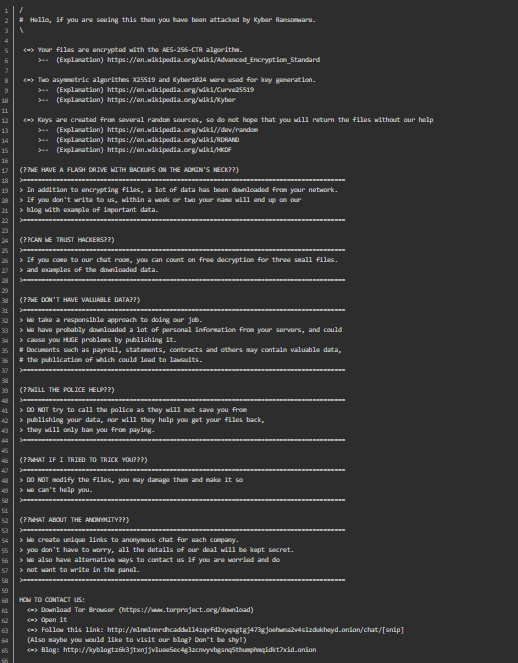
Kyber ransom note.
Expertise:
- Cross-platform payloads: Windows (Rust) and Linux/ESXi (C++)
- ESXi variant includes datastore encryption, optional virtual machine termination, and defacement of management interfaces; Windows variant includes an experimental Hyper-V targeting feature
- Hybrid encryption using AES-256-CTR with X25519 and Kyber1024, with explicit claims of mass data exfiltration prior to encryption
- Background execution via process detachment, allowing operators to safely disconnect while encryption of datastores continues uninterrupted
- Anti-recovery: the Windows variant executes 11 anti-recovery commands requiring elevation
Motivations
Double extortion — combining file encryption with data theft and leak threats — using coercive communication tactics and leak-based intimidation to maximize victim compliance. To prove decryption capability and build trust, the group offers free decryption for three small files and provides samples of stolen data upon request.
No confirmed ransom payment amounts are publicly disclosed at this time. Kyber is assessed as an emerging high-tier actor with demand amounts not yet documented in open sources.
Timeline & Victimology
October 2025 — Emergence
Kyber was identified as a new ransomware group in the third week of October 2025, alongside several other newly emerged threat actors. Early analysis assessed Kyber as rapidly evolving toward double- and triple-extortion models, with Tor-based anonymous infrastructure and professionalized negotiation workflows already in place.
October–March 2026 — Capability Development
Kyber developed cross-platform payloads targeting both Linux/ESXi and Windows environments, sharing campaign identifiers and Tor infrastructure across both variants — confirming coordinated, multi-platform operations.
March–April 2026 — Confirmed Enterprise Intrusions
During a March 2026 incident response engagement, two Kyber ransomware payloads were deployed in the same enterprise environment — one targeting VMware ESXi infrastructure and the other Windows file servers. Kyber’s experimentation with post-quantum encryption (Kyber1024) and multi-platform ESXi targeting have been flagged by threat intelligence trackers as a notable technical trend.
Tactics & Techniques
Initial Access
- Exploit Public-Facing Application — T1190 (vCenter and internet-exposed services)
- Valid Accounts — T1078
Execution
- Command and Scripting Interpreter — T1059
- Windows Management Instrumentation — T1047
Persistence
- Persistence mechanisms including autostart entries and system setting modifications to maintain a foothold — T1547
Defense Evasion
- Process Injection / Fork+Execlp to bypass shell — T1055
- Background detachment via setsid() to survive SSH session termination
Discovery
- File and Directory Discovery — T1083
- Virtualization/Sandbox Evasion (ESXi environment checks) — T1497
Lateral Movement
- Remote Services — T1021
Collection & Exfiltration
- Claims of mass data exfiltration from victim networks prior to encryption, with stolen data held as leverage — T1119, T1567
Impact
- Data Encrypted for Impact — T1486
- ESXi variant enumerates and terminates virtual machines prior to encrypting datastores under /vmfs/volumes
- Inhibit System Recovery (Windows anti-recovery commands) — T1490
Defensive Recommendations Against Kyber
- Restrict vCenter and ESXi management interfaces from public internet access; patch internet-facing services promptly, especially vCenter
- Monitor for anomalous esxcli usage, snapshot deletion, datastore encryption activity, and unusual VM termination sequences
- Maintain offline backup copies stored on physically disconnected media and test restoration procedures regularly
- Prioritize pre-encryption detection: focus on data exfiltration signals, privilege escalation, and lateral movement rather than waiting for ransomware deployment
- Implement network segmentation to limit lateral movement from compromised internet-facing hosts to hypervisor infrastructure
- Deploy behavioral anomaly-based detection technologies capable of identifying ransomware attacks in early stages
References
Bleeping Computer. Kyber ransomware gang toys with post-quantum encryption on Windows. https://www.bleepingcomputer.com/news/security/kyber-ransomware-gang-toys-with-post-quantum-encryption-on-windows/
Ransomware.live. Kyber. https://www.ransomware.live/group/kyber
Rapid7 Threat Research. Kyber Ransomware Double Trouble: Windows and ESXi Attacks Explained. https://www.rapid7.com/blog/post/tr-kyber-ransomware-double-trouble-windows-esxi-attacks-explained/
CYFIRMA. Weekly Intelligence Report – 31 October 2025. https://www.cyfirma.com/news/weekly-intelligence-report-31-october-2025/
Anavem. Kyber Ransomware Targets VMware ESXi with Quantum Encryption. https://www.anavem.com/en/news/cybersecurity/kyber-ransomware-targets-vmware-esxi-with-quantum-encryption