
Aliases
- Medusa Blog (the group’s leak-site branding)
- Storm-1175 (Microsoft designation for a China-based Medusa affiliate)
Get Threat Intel and Security Updates Delivered to Your Inbox.
Profiling
Threat Actor Type: Financially motivated ransomware-as-a-service (RaaS) operation using encryption, data theft, and leak-site extortion. Active since June 2021; a joint CISA, FBI, and HHS advisory updated in August 2026 counts more than 500 critical infrastructure victims.
Structure:
- Closed group until early 2023, then opened an affiliate program
- Core operators maintain the encryptors, leak site, and negotiation infrastructure; affiliates conduct intrusions
- Access often bought from initial access brokers for $100 to $1 million
Affiliates:
- Storm-1175 (Microsoft): China-based, financially motivated; exploited GoAnywhere MFT and SmarterMail flaws before public disclosure and reaches encryption in about 24 hours
- Lazarus Group (North Korea): linked by Symantec and Carbon Black to Medusa attacks on U.S. healthcare organizations and nonprofits, November 2025–February 2026
Tradecraft:
- Weaponizes newly disclosed vulnerabilities within 24 hours and uses vulnerability announcements to pick targets
- Relies on living-off-the-land tooling and legitimate RMM software
- Loads vulnerable kernel drivers to kill EDR before deployment
Extortion:
- Countdown timer on the Medusa Blog; $10,000 buys a one-day extension
- FBI documented a paying victim contacted by a second “Medusa negotiator” demanding half the ransom again
Malware:
- Windows encryptor (gaze.exe) appends .medusa and drops !!!READ_ME_MEDUSA!!!.txt
- Linux/ESXi-targeted variant transferred to targets over secure file transfer
- Federal advisories document affiliates manually shutting down and encrypting virtual machines
- In VMware environments, affiliates log in to vCenter or ESXi with stolen credentials, stop running VMs with esxcli, and encrypt .vmdk files at rest
Motivations
Financial extortion through encryption and stolen-data pressure. Nation-state affiliates participate for revenue; there is no evidence of state direction over the core operation.
Timeline & Victimology
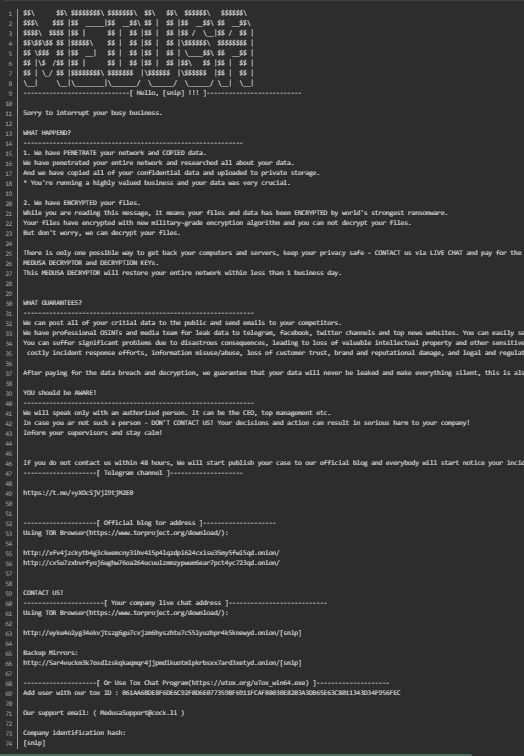
Figure 1: Medusa ransom note.
June 2021 — Emergence
Medusa surfaces as a closed ransomware group, with core operators handling intrusions and negotiations.
Early 2023 — RaaS Launch
- Medusa opens its affiliate program and launches the Medusa Blog
- First leak-site victims appear in February 2023
March 2025 — First Federal Advisory
- CISA, FBI, and MS-ISAC report more than 300 victims across healthcare, education, legal, insurance, technology, and manufacturing
- Advisory documents affiliates accessing VMware vCenter or ESXi hosts with stolen credentials, shutting down running virtual machines with esxcli, and encrypting .vmdk files at rest
November 2025–February 2026 — Lazarus Group Affiliate Activity
Symantec and Carbon Black tie North Korea’s Lazarus Group to Medusa attacks on U.S. healthcare organizations and nonprofits.
February 2026 — University of Mississippi Medical Center
- Takes down Mississippi’s only Level I trauma center, children’s hospital, and organ transplant program
- Systems offline for nine days; all 35 outpatient clinics closed
February 2026 — BeyondTrust Exploited Within 24 Hours
Affiliates begin exploiting BeyondTrust Remote Support and Privileged Remote Access (CVE-2026-1731) within a day of disclosure.
April 2026 — Storm-1175 Attribution
Microsoft identifies Storm-1175 as a China-based Medusa affiliate exploiting vulnerabilities before patches were available.
August 2026 — Updated CISA/FBI/HHS Advisory
- Victim count passes 500
- Defense, government, IT, and financial services added to the sector list
- Documents Linux encryptor deployment and new tooling: GSocket, Nezha, MeshAgent, Ligolo-ng
September 2026 — Active and Ongoing
- 517 publicly tracked victims across 50 countries; 262 in the U.S.
- Healthcare remains the most consistently targeted sector
- No law enforcement disruption reported
Tactics & Techniques
Initial Access
- T1190 – Exploit public-facing applications (ScreenConnect, FortiClient EMS, GoAnywhere MFT, BeyondTrust)
- T1078 – Valid accounts purchased from access brokers
- T1566 – Phishing
- T1133 – External remote services
Execution & Persistence
- T1059.001/ T1059.003 – PowerShell and command shell
- T1047 / T1569.002 – WMI and service execution (PsExec, PDQ Deploy)
- T1219 – Remote access software (AnyDesk, SimpleHelp, ConnectWise, Atera, Nezha, MeshAgent)
Credential Access & Discovery
- T1003 – Credential dumping (Mimikatz)
- T1018 / T1046 – System and service discovery (Advanced IP Scanner, SoftPerfect, NetExec)
- T1135 / T1482 – Network share and domain trust discovery
Lateral Movement
- T1021.001– Remote Desktop Protocol
- T1021.004– SSH to Linux, vCenter, and ESXi hosts
- T1570 – Lateral tool transfer
Defense Evasion
- T1562.001– BYOVD kernel-driver EDR termination
- T1562.009– Safe Mode boot to bypass security tools
- T1027 / T1036 – Obfuscation and masquerading
Exfiltration & Command and Control
- T1560.001 / T1567 – Archive and exfiltrate to web services
- T1572 / T1090 – Tunneling and proxy infrastructure (Ligolo-ng, Cloudflared, GSocket, FRP)
Impact
- T1486 – Data encrypted for impact (Windows, Linux, and ESXi VM files)
- T1529 – Running VMs stopped before encryption
- T1490 – Inhibit system recovery
- T1657 – Financial extortion
Defensive Recommendations Against Aurora
Watch the hypervisor directly. Medusa’s Linux/ESXi encryptor runs where Windows EDR has no presence. Use runtime behavioral detection on ESXi hosts and alert on bulk VM shutdowns, esxcli vm process kill, and mass .vmdk changes.
Isolate ESXi and vCenter management. Keep management interfaces off the user LAN, disable ESXi SSH when not in use, and require MFA on vCenter. Separate hypervisor administration from production Active Directory.
Patch internet-facing systems within 24 hours. Prioritize ScreenConnect (CVE-2024-1709), FortiClient EMS (CVE-2023-48788), GoAnywhere MFT (CVE-2025-10035), and BeyondTrust (CVE-2026-1731).
Control remote access tools. Maintain an approved RMM list and alert on any other RMM, tunneling, or reverse-proxy tool, especially on servers.
Block driver-based EDR killing. Enforce HVCI and the Microsoft vulnerable driver blocklist, and alert on unexpected bcdedit Safe Mode changes. Use protection that cannot be terminated from a compromised guest.
Plan recovery without the decryptor. Keep immutable, offline backups of VMs and hosts. Post-payment extortion is documented, and deletion from the leak site cannot be verified.
References
BleepingComputer. CISA: Medusa Ransomware Hit Over 500 Critical Infrastructure Orgs. https://www.bleepingcomputer.com/news/security/cisa-medusa-ransomware-hit-over-500-critical-infrastructure-orgs/
BleepingComputer. North Korean Lazarus Group Linked to Medusa Ransomware Attacks. https://www.bleepingcomputer.com/news/security/north-korean-lazarus-group-linked-to-medusa-ransomware-attacks/
CISA. #StopRansomware: Medusa Ransomware. https://www.cisa.gov/news-events/cybersecurity-advisories/aa25-071a
Cloud Security Alliance. Storm-1175: Zero-Day Exploit Chains in Medusa Ransomware Attacks. https://labs.cloudsecurityalliance.org/research/csa-research-note-storm1175-medusa-ransomware-zero-day-20260/
Help Net Security. Medusa Ransomware Gang Has Hit Over 500 Organizations, CISA Warns. https://www.helpnetsecurity.com/2026/08/19/medusa-ransomware-cisa-warning/
Industrial Cyber. FBI, CISA, HHS Update Medusa Ransomware Advisory. https://industrialcyber.co/cisa/fbi-cisa-hhs-update-medusa-ransomware-advisory-detail-raas-affiliate-model-exploited-flaws-and-attack-tools/
Petronella Technology Group. Medusa Ransomware Defense Guide (2026 Update). https://petronellatech.com/blog/medusa-ransomware-defense-guide
Ransomware.live. Medusa Group Profile. https://www.ransomware.live/group/medusa
The Record. Medusa Ransomware Gang Claims Attacks on Prominent Mississippi Hospital. https://therecord.media/medusa-ransomware-mississippi-cyber